 现任成员
现任成员An approach of piezoelectric assisted chemical mechanical polishing using BaTiO3 abrasives and hydrogen peroxide
一种基于钛酸钡(BaTiO3)磨料与过氧化氢的压电辅助化学机械抛光方法
QingjieYang, Qirong Zhu, Xueting Liu, Qingxiu Yang, Mingzhe Li, Siwen Yu, Jianjun Guo, Dingyi Tong*, Aihua Sun*, Yuchuan Cheng*
杨青杰,朱启榕,刘雪婷,杨清秀,李明哲, 余四文,郭建军,童丁毅*,孙爱华*,程昱川*
全文链接:https://pubs.acs.org/doi/full/10.1021/acsanm.6c00206
Abstract
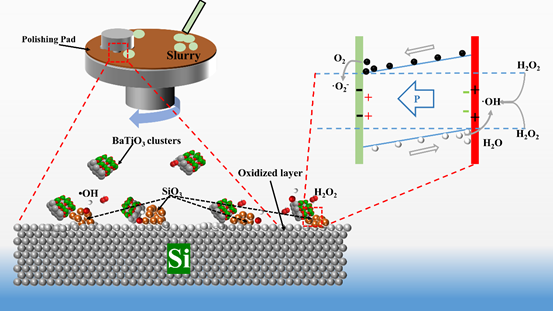
目前的化学机械抛光(CMP)工艺在减少或消除额外氧化剂及外部能量输入方面仍面临严峻挑战。本研究提出了一种绿色、高效的 CMP 策略,巧妙利用钛酸钡(BaTiO3)的压电效应来增强抛光过程。通过采用五因素正交实验设计,系统研究了关键工艺参数对硅片抛光过程中材料去除率(MRR)的影响。经参数优化,该工艺实现了高达 436 nm·min-1 的超高材料去除率,同时获得了极低的表面粗糙度(Ra = 0.253 nm)。在施加的抛光压力下,四方相 BaTiO3 颗粒原位产生活性氧(ROS)。少量过氧化氢(H2O2)的加入进一步放大了这一效应:H2O2 不仅作为催化底物,还充当电子清除剂,显著加速了硅表面疏松且易去除的氧化层的形成。同时,BaTiO3 颗粒作为磨料机械剥离该氧化层,从而构筑了协同的“氧化-机械磨损”机制。该机制已通过 ESR(电子自旋共振)和 XPS(X 射线光电子能谱)表征得到证实。值得注意的是,整个抛光过程无需加热、光照或外加电场等额外能量输入,仅凭常规 CMP 设备的标准机械作用即可实现高效加工。因此,该方法为全球硅片平坦化提供了一种创新、环保且高效的解决方案。
Current CMP processes still face significant challenges in minimizing or eliminating the use of additional oxidants and/or external energy inputs. In this work, we present a green and highly efficient CMP strategy that ingeniously harnesses the piezoelectric effect of barium titanate (BaTiO3) to enhance the polishing process. A five-factor orthogonal experimental design was employed to systematically investigate the influence of key process parameters on the material removal rate (MRR) during silicon wafer polishing. Through parameter optimization, the process achieved an exceptionally high MRR of 436 nm·min-1, accompanied by an ultralow surface roughness (Ra = 0.253 nm). Under the applied polishing pressure, tetragonal-phase BaTiO₃ particles generate reactive oxygen species (ROS) in situ. The addition of a small amount of hydrogen peroxide (H2O2) further amplifies this effect: H2O2 acts not only as a catalytic substrate but also as an electron scavenger. Significantly accelerates the formation of a soft and easily removable silicate oxide layer on the silicon surface. Simultaneously, the BaTiO3 particles serve as abrasives, mechanically removing this oxide layer and thereby establishing a synergistic “oxidation–abrasion” mechanism. The mechanism was confirmed by ESR and XPS characterization. Notably, the entire polishing process requires no additional energy input such as heating, light irradiation, or external electric fields and operates efficiently using only the standard mechanical action of conventional CMP equipment. This approach thus offers an innovative, environmentally sustainable, and highly effective solution for global silicon wafer planarization.